

ENCORE (Environmental Corruption Response) is an EU-funded project coordinated by the Siracusa International Institute for Criminal Justice and Human Rights, that focuses on the corruption–pollution nexus and the ways in which bribery, undue influence and fraud can enable environmental crimes such as illicit trafficking in waste and F-gases. Through a combination of research, intelligence analysis and capacity-strengthening activities, the project seeks to strengthen the European response to corruption as a facilitator of pollution crimes, developing practical guidance, risk indicators and user-friendly tools to support competent authorities, customs, environmental inspectorates, prosecutors and police in preventing, detecting and investigating these offences, and contributing to evidence-based policy responses across Europe.
Practical guidance now available to law enforcement on the ENCORE Online Platform
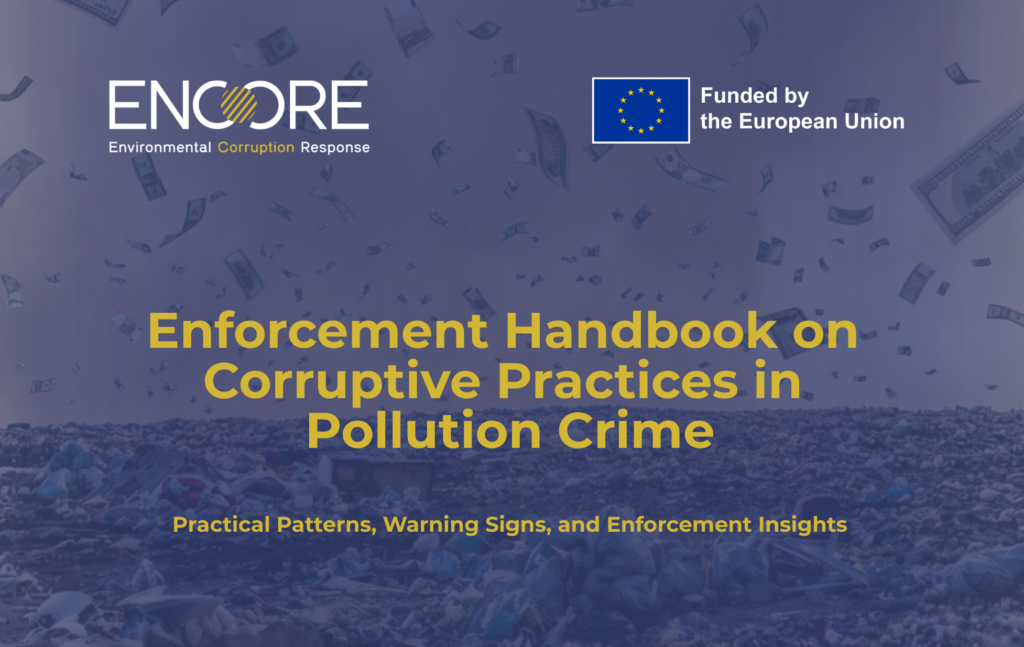
The ENCORE project announced the publication of the Enforcement Handbook on Corruptive Practices in Pollution Crime – Practical Patterns, Warning Signs, and Enforcement Insights. The Handbook is now available to law enforcement practitioners on the ENCORE Online Platform.
Corruption is an important enabler of pollution crime, yet it often remains hidden behind apparent regulatory non-compliance. Illegal waste trafficking and the illegal trade in fluorinated greenhouse gases (F-gases) thrive on complex regulatory systems, cross-border trade flows, documentation requirements and public authorisations, all points where bribery, undue influence and fraud can open the door to criminal activity.
The new Handbook is ENCORE’s practical answer to this challenge: a user-friendly tool designed to raise awareness and understanding of corrupt practices in pollution crime, including the different modus operandi, the actors involved, the vulnerability nodes in the enforcement chain, and the risk indicators that help practitioners spot them.
The Handbook is built on a combination of legal analysis, operational experience, case studies and practical tools. It is structured to move from context to practice: it first sets out the legal trade in waste and F-gases and the drivers for circumventing the rules, before turning to where corruption may enter the inspection and enforcement chain, procurement, licensing and permitting, inspections and monitoring, enforcement and follow-up, and the prosecution and judicial stages. Further sections examine the convergence of pollution crime with fraud, money laundering and organised crime, the roles of the many actors who can help detect and investigate these offences, and practical investigation strategies. The Handbook closes with practical takeaways, recommendations, real-life case studies and operational red flags to support awareness-raising, training, risk assessment, case screening and cooperation between authorities.
Developed on the basis of a desk review of open sources, semi-structured interviews with law enforcement practitioners, and the analysis of case studies, the Handbook is intended for environmental authorities, customs, law enforcement, prosecutors, anti-corruption bodies, financial intelligence units and other relevant actors. As it addresses different professional audiences, it does not need to be read cover to cover: practitioners are encouraged to focus on the sections most relevant to their role and expertise.
Please note: the Handbook is intended exclusively for law enforcement personnel and is provided under the terms of the ENCORE project. Its contents may not be published, reproduced or disclosed, in whole or in part, to individuals or entities outside law enforcement agencies. Eligible practitioners can access the Handbook on the ENCORE Online Platform.
Applications open: First ENCORE Online Training Session for Law Enforcement
Alongside the launch of the Handbook, we also wish to remind readers that applications are open for the first ENCORE online training session for law enforcement, which will take place in late October 2026.
The training session marks the start of ENCORE’s capacity-strengthening activities and offers law enforcement practitioners the opportunity to engage directly with the corruption–pollution nexus, deepen their understanding of how corruption facilitates pollution crime, and exchange views with peers and experts from across Europe. Eligible enforcement and criminal justice officials are encouraged to apply via the ENCORE Online Platform.
Places are limited, so interested applicants are encouraged to apply early. Further information is available at this link.
Learn more about the ENCORE project here.